
Last updated on April 1, 2026
(1746–1799)
The reburial of Rev. William Graham is one of several reinternments that have occurred on campus. In a series we’re calling Reinterred and Reinterpreted, we will take a closer look at the lives of some of these individuals, their connections to W&L, and the stories of their reburial.
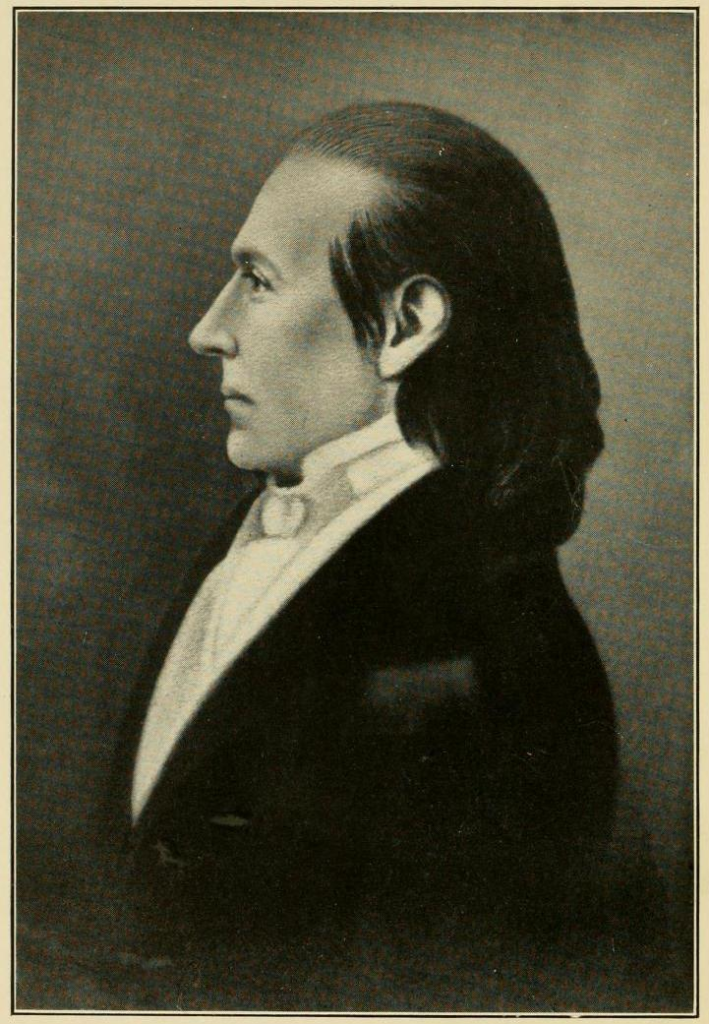
“28-year-old William Graham was described as “medium height, his eyes were dark, and he had a slender, delicate frame.”
Born December 19th, 1746, in Pennsylvania to Presbyterian Irish immigrants, Reverend William Graham attended the College of New Jersey, modern-day Princeton University. Also studying there were Samuel Stanhope Smith (1751–1819), minister and founder of Hampton-Sydney College, and Revolutionary War soldier, Governor, and father of Robert E. Lee (1807–1870), Henry Lee III (1756–1818). before returning to Pennsylvania to study theology.
In October 1774, he was recommended to the Hanover Presbytery to become the steward of a proposed “school for the liberal education of youth.” The public school was to be in Augusta Academy and “be managed by Mr. William Graham, a gentleman properly recommended to this Presbytery.”
In 1776, the school moved five miles south to Timber Ridge as Graham, now rector of the school, had accepted a call to be a pastor at Timber Ridge Presbyterian Church. The school was renamed Liberty Hall Academy, likely in honor of the American Revolution. Around the same time, Graham married Mary Kerr (unknown dates). They had at least five children together, including William, who received free tuition from his father’s institution in the early 1800s.
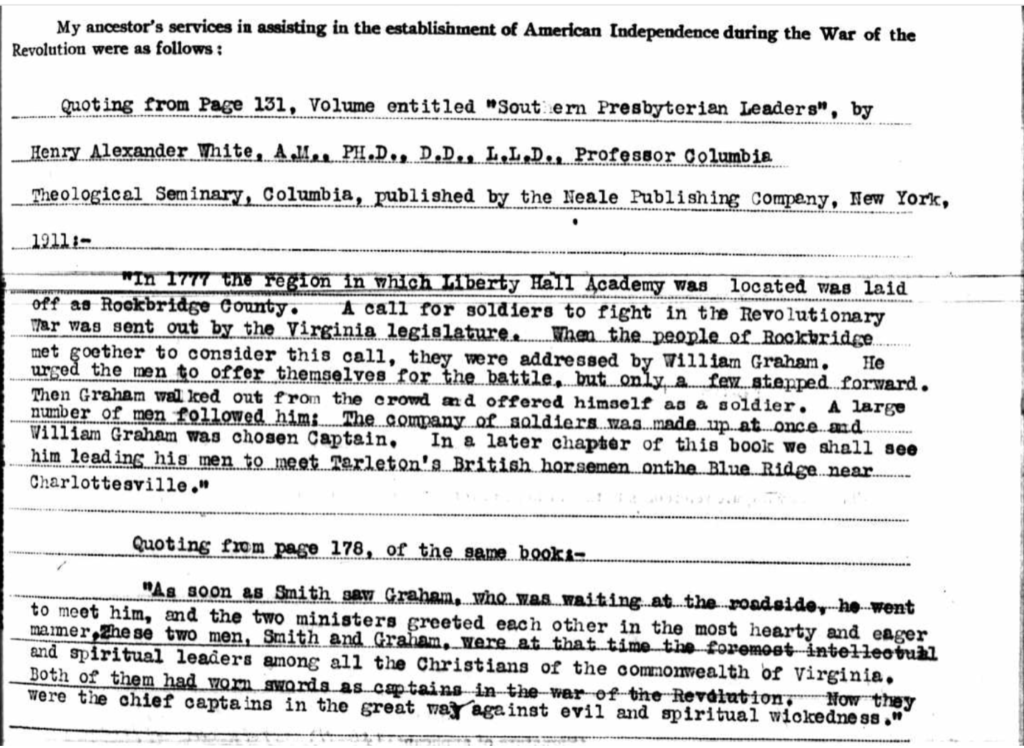
During the Revolutionary War, records state that Graham continued to teach out of his home. Graham’s descendants claim (as seen in a descendant’s application to join the Sons of the American Revolution) that when a call for soldiers came to Rockbridge County, only a few men stepped forward to volunteer. Graham walked through the crowd and offered himself up to service, prompting several others to follow suit. Due to Graham’s sense of leadership and selflessness in that moment, it is said he was awarded the title of Captain. However, it is debated whether Graham ever went to battle. Some records claim his company operated out of Rockbridge County, while others claim that George Washington held reservations that volunteers like Graham were not suited for war, resulting in the retraction of Graham’s military orders.
Liberty Hall struggled during the American Revolution as many students—and possibly Graham—left to fight in the Continental Army. Additionally, the war brought various financial hardships. Graham and his family relocated six miles south in hopes of establishing a bountiful farm to offset some of the costs of living. He agreed with the Trustees to travel to the Academy weekly, but that soon became an impractical arrangement. In 1779, the trials of war became too large, and the school suspended classes indefinitely. However, evidence claims that Graham continued to teach students in his new private residence on Mulberry Hill outside Lexington during the war and continued to fundraise for the Academy.
In 1782, Graham and two of his neighbors donated 19 acres for the re-establishment of Liberty Hall. Graham later petitioned for an Act of Incorporation with the Virginia General Assembly, which was granted and established Liberty Hall Academy as an authorized institution to confer college degrees. Later, Graham’s perseverance earned the school a gift from George Washington, which saved the school from financial ruin.
Graham resigned in 1796 and then moved his family to a site near the Ohio River in modern-day West Virginia. On a trip to Richmond, Graham fell ill and died. He was buried there in 1788. However, his body and gravestone were moved to Lexington in May 1911.
The re-interment of the body of Dr. William Graham has called to our minds the life of a man to whom, as much as to any other one man, the college owes its existence. It has brought to the attention of the present student body, with renewed emphasis, the self-sacrificing endeavors of a noble man who, through difficulties not sufficiently appreciated by us of later years, labored diligently to a worthy end. It was fitting that such an honor should be paid to the man whose connection with the college was so intimate and that he be laid to rest amid the scenes where he labored. It will make the surroundings of the University if possible even more sacred, to realize than another such honored patriot has his last resting place on the campus.
Further Reading:
“A Memoir of the Late Rev. William Graham, AM”, The Evangelical & Literary Magazine,” February 1821
Comments are closed, but trackbacks and pingbacks are open.