

Peabody Professor of Latin, Washington and Lee University 1893-1896
As we familiarize ourselves with the history of Washington and Lee University, sometimes it is fun to throw the proverbial dart at a map and go down the research rabbit hole relating to its landing zone (apologies for the mixed metaphors, but you know where we’re going with this…).
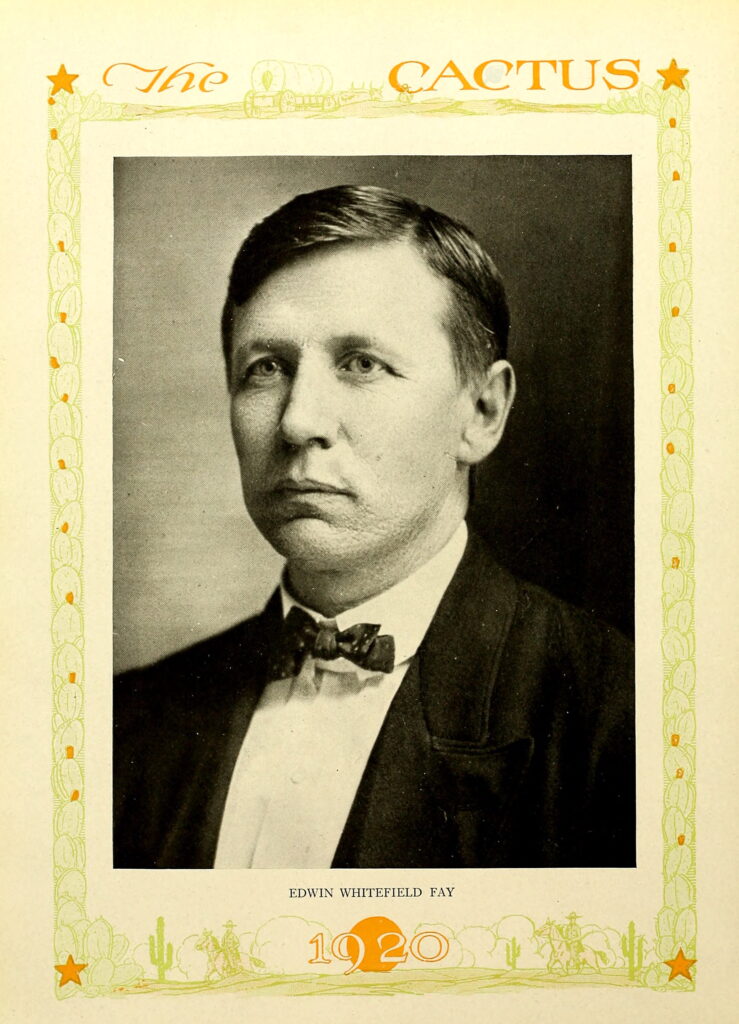
In the archival issues of the Ring-Tum Phi, we came across a simple sentence in the “Personal Mention” column—the campus equivalent of the society pages—that caught our attention: “Miss Fay of New Orleans, who has for several weeks been visiting her brother, Professor Edwin W. Fay, is ill with fever.”

Who was Professor Fay, and what happened to his sister?
What emerged was a glimpse into an interesting time in W&L’s history, a wide web of familial academic pedigree, and university connections that stretched from Lexington to Texas, Tennessee, New York, and beyond. It also brought into the spotlight the short but prolific career of the brilliant linguist, philologist, and Indologist Dr. Edwin Whitfield Fay (1865–1920), who spent six academic years at W&L. Philology is the study of language in oral and written form. Indology refers to the study of South Asian culture and language with a focus on India.
From the fall term in 1893 through the end of the 1899 spring term, Dr. Edwin Whitfield Fay was the Peabody Professor of Latin, an endowed position with roots in the 1867 donation by philanthropist George Peabody in honor of the college President, Robert E. Lee. Fay took over the position from Professor C. J. Harris, Emeritus Professor of Latin, who passed away in 1894.
As described by an admiring former student a half century later, Professor Fay was memorable: “Dr. Edwin Fay (Patsy) was a professor of Latin and a gifted linguist. He was an old bachelor when he came to Lexington, a bookworm, and set in his ways….” The former student, Randolph Preston Sr., ’1902 (1880–1957, wife, Julia Jackson Christian- the granddaughter of Thomas “Stonewall” Jackson; Attorney in Washington, DC and Charlotte, NC, member of North Carolina State Legislature, former Special Assistant to the Attorney General of the United States, and former trial examiner for the Federal Trade Commission, ), went on to elaborate on Fay’s…idiosyncrasies; or at least, his rumored idiosyncrasies:
It was a campus joke that upon arriving he told his landlady that his digestion was very poor, and he would have to request that his food be prepared exactly at the temperature of his lips, whereupon some local wag suggested that the only way this could be accomplished would be for him to go out before each meal and kiss the cook.
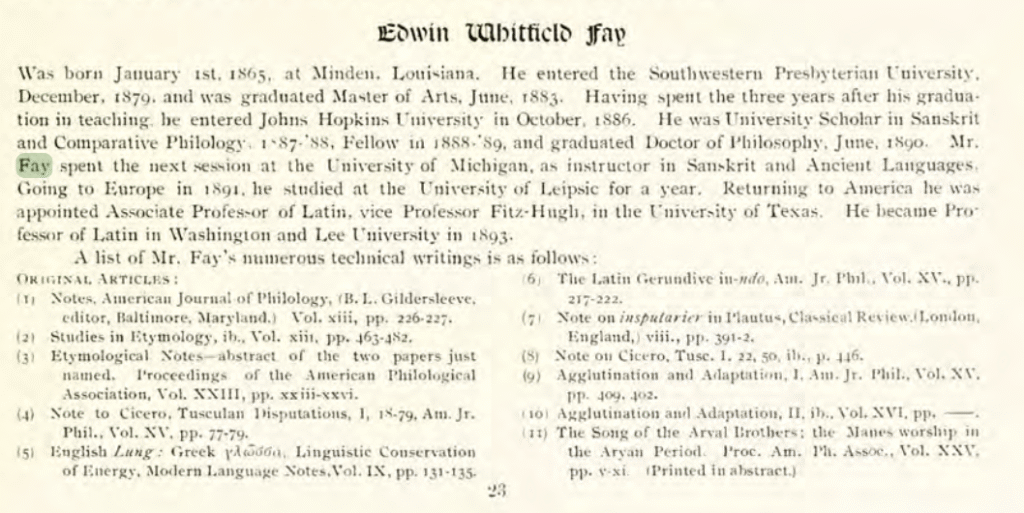
Whether rooted in truth or exaggeration, the anecdote seems to have made Fay as memorable for his quirks as his smarts. Other tributes to Dr. Fay focus on his brilliance and prolific writings; peers and biographers have noted his interest in modern literature, his ongoing study of the Bible, and his skill at writing verse, playing piano, and playing tennis. In his career, Dr. Fay produced nearly two hundred academic articles which appeared in numerous journals and publications, as well as three books: A History of Education in Louisiana (1898), The Treatment of Rig-Veda Mantras in the Yrhya Sutras (1899, from his dissertation completed in 1890), and T. Macci Planti Mostellaria (1902). Most of his publications are related to his specialty, Sanskrit and comparative linguistics.

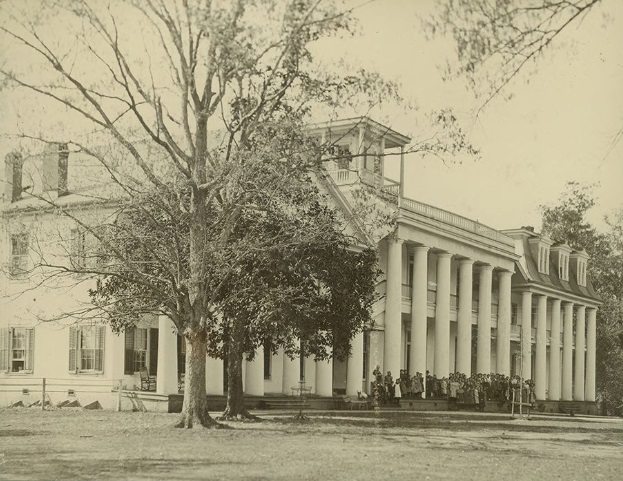
Born on January 1, 1865, to Sarah Elizabeth Shields (1837–1919) and Edwin Hedge Fay (1832–1898) in Minden, Louisiana, Edwin’s academic path seems predestined. The elder Edwin was a noted educator and graduate of Harvard who became the State Superintendent of Public Instruction in Louisiana (1880–1884). The younger Edwin was educated by his father, principal of the Silliman Institute, having received special permission to attend the respected girls’ school in Clinton, Louisiana.
The Silliman Female Collegiate Institute operated from 1852 to 1931; from 1852 until 1866, it was a women’s college. In 1866, the campus was given to the Louisiana Presbytery, which operated it as Silliman College until 1931. Edwin Whitfield Fay would have attended the school sometime between his father’s appointment as principal in 1872 and 1879 before entering college. The school was noted for prioritizing “courses in mathematics, natural sciences, English and foreign languages, government and history, and the fine arts.”
Fay went on to attend Southwestern Presbyterian University in Clarksville, Tennessee (M.A. 1883), now Rhodes College, and completed his Ph.D. at Johns Hopkins University in Baltimore in 1890. In between his M.A. and attending Johns Hopkins, Fay honed his classroom skills as a high school teacher in Jackson, Mississippi, and Beaumont, Texas. Fay spent 1890–1892 in Europe furthering his studies at Universität Leipzig under Karl Brugmann (1849–1919) and Wilhelm Oscar Ernst Windisch (1844–1918); while there, he was Instructor of Sanskrit and Classics for Michigan University. He spent a single academic year, 1892–1893, as Associate Professor of Latin at the University of Texas at Austin before arriving at Washington and Lee.
The period Dr. Fay spent at W&L is interesting in that it can best be described as a lull, respectfully of course. The mid-to late-1890s in Lexington were much like those of the rest of the country. Returning to the words of Randolph Preston Sr.,
The panic of 1893 (often miscalled by the Republicans, “the Cleveland panic”) had caused great financial loss and hardship in the nation, especially in the South, and many families found it impossible to send their sons to college…. In 1900, the college had about 20 professors and associate professors, many of them outstanding men.
Dr. Fay recognized the financial limitations of the college and sought outside aid from the president of Johns Hopkins University, Daniel Coit Gilman (1831–1908) in 1896. That September, early in the academic term, Fay wrote to President Gilman requesting help in applying for a Peabody Library Catalogue for use in W&L’s university library (the ultimate success of this inquiry is unknown). Fay writes that the catalog would:
…help our librarian [Annie Joe Robertson White (1853–1938), served 1895-1922] who has been studying for two summers at Amherst- in the work of classification. This can only be come at, our understand, by way of a gift. May I ask you to broach the matter to the Provost, Mr. W(…) for me? Our college happens to have been one of Mr. Peabody’s wards. Our gift from him, originally amounting to almost $250000, was considerably larger when we realized from it. My own chair of Latin is named in honor of this gift the Peabody Professorship. These facts would give a special fitness to a gift of a catalogue to us.
Letters from E.W. Fay to President Gilman, 1896, extracted from Daniel Coit Gilman papers, Johns Hopkins University Sheridan Libraries

Letters from E.W. Fay to President Gilman, 1896, extracted from Daniel Coit Gilman papers, Johns Hopkins University Sheridan Libraries

Letters from E.W. Fay to President Gilman, 1896, extracted from Daniel Coit Gilman papers, Johns Hopkins University Sheridan Libraries

Letters from E.W. Fay to President Gilman, 1896, extracted from Daniel Coit Gilman papers, Johns Hopkins University Sheridan Libraries
The original financial gift Fay refers to came in two parts, beginning in 1867, and was given in honor of Robert E. Lee (1807–1870). The lack of university funds available to spend on such an investment is reinforced by another letter sent from Fay to Gilman dated that same day, in which Fay pledged a personal contribution to Johns Hopkins’ Emergency Fund to recur annually for five years, “provided my circumstances continue approximately the same.” Fay further expresses concern that this continuation may not be the case as “our salaries here will fall some $200.00 below the average this year on account of a decrease in students, salaries being partly contingent on tuition fees.”
Randolph Preston corroborates this financial strain, noting, “My recollection is that around 1900, the enrollment sank to 300 or less, and cynics were predicting that unless something radical was done (perhaps heroic is a better word) the old college might have to go out of existence as a number of others were doing.” Whether these financial shortfalls were the ultimate reason for Fay’s departure to U. T Austin remains unclear, but his departure in 1899 opened the door for the arrival of another Professor of Latin who would go on to play an even larger role in the history and evolution of the W&L campus and the University of Alabama, George H. Denny (1870–1955).[GR2] Denny became President of the university in 1901 and resigned to assume the presidency at Alabama in 1912.

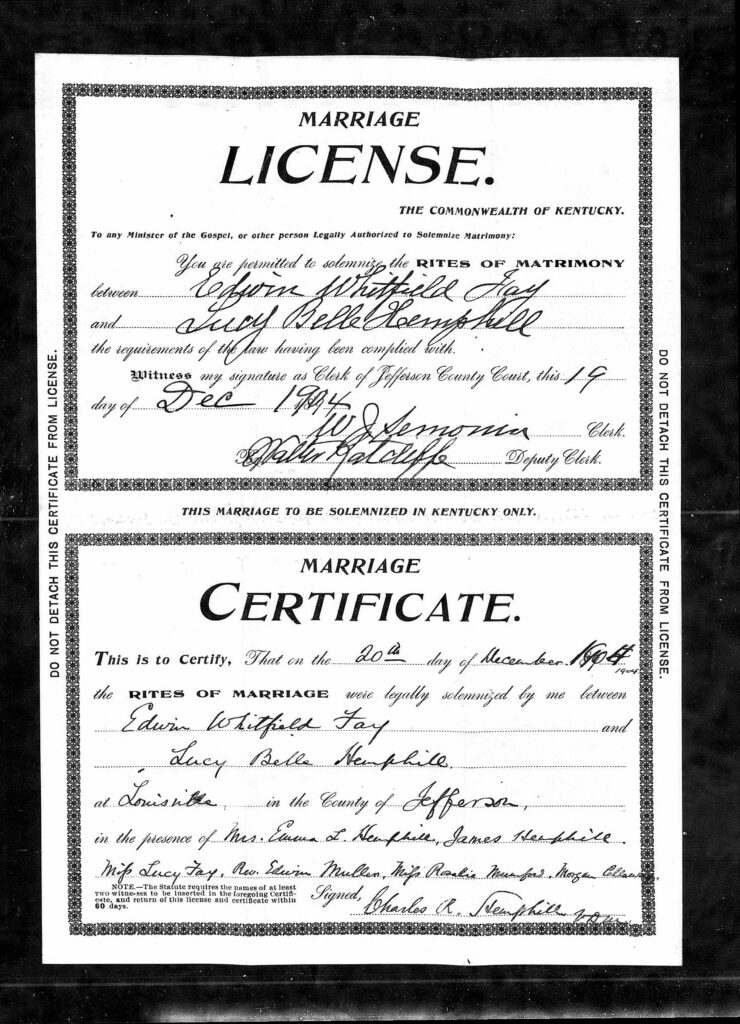
Though described as a lifelong bachelor, “ love overtook Dr. Fay late in life and he married a Miss Hemphill [Lucy Belle Hemphill (1876–1963)], the charming daughter of the Rev. Dr. Charles R. Hemphill, a distinguished Presbyterian minister of Louisville, Ky., was much improved by matrimony as all of us are, and had a very happy life.” The couple married in December 1904 and had two sons together: Edwin Whitfield Fay Jr. (1907–1909) and Charles Hemphill Fay (1910–1987).
Sadly, Dr. Fay’s life and career came to an abrupt end in February 1920. While in Pittsburgh, PA, he died of pneumonia brought on by influenza. Joining the family in their grief were Fay’s colleagues and students. The University of Texas closed in response to the news of his passing. Fay was buried in Austin’s Oakwood Cemetery. In May 1920, his faculty colleagues penned a tribute to their friend, which was printed in the Austin American-Statesman. Fay’s widow, Lucy, remained in Texas for the rest of her life, with a brief exception of a period in the mid-1930s in which she returned to Kentucky to care for an ailing family member. Mrs. Fay never remarried, and her surviving son, Charles Hemphill Fay, went on to a brilliant academic career as a physicist.
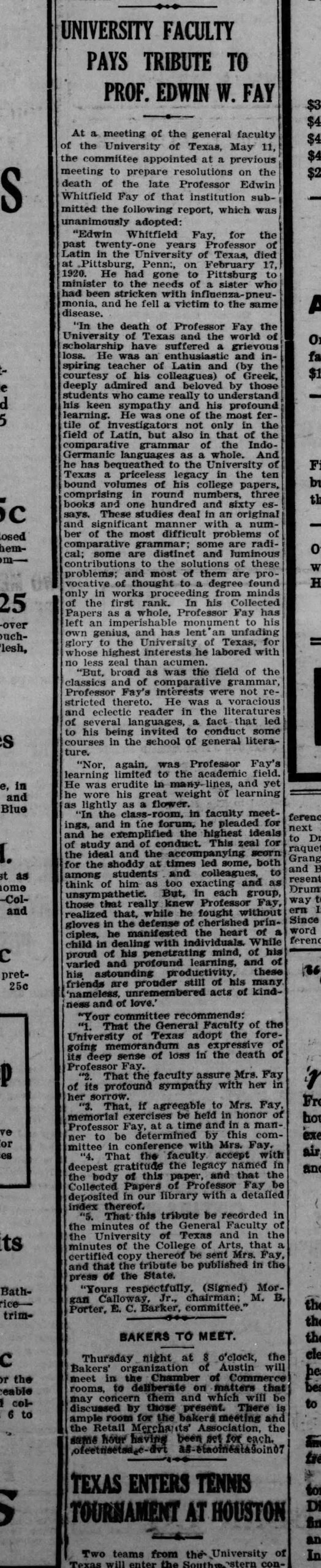
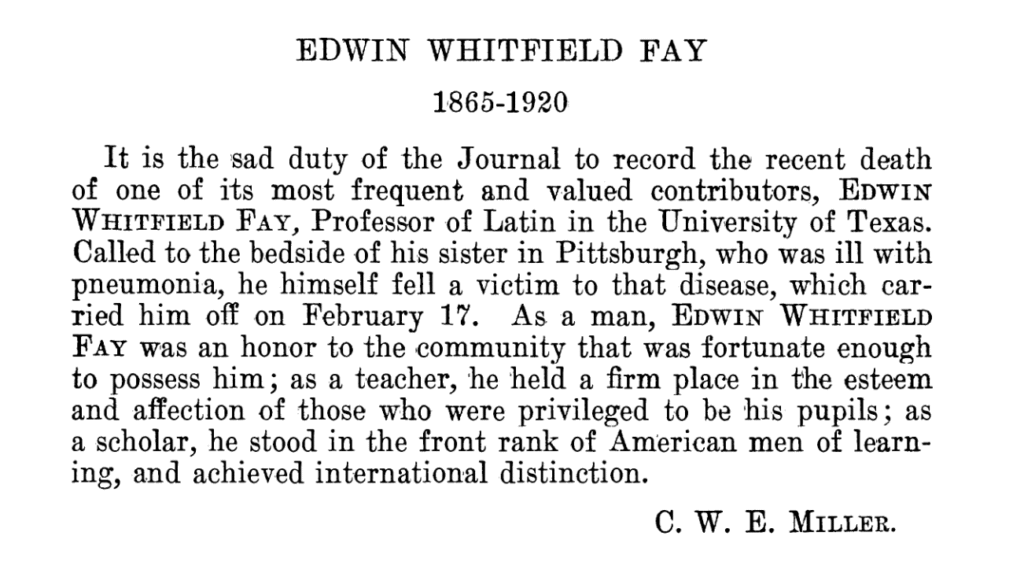
Since his passing, Fay’s legacy for his contributions to the study of Sanskrit and philology extends far beyond his immediate peers. In 1924, Morgan Callaway Jr. (1862–1936) edited a memorial to him in the U. Texas Bulletin that has proved to be a valuable resource for future researchers aiming to give Dr. Fay his due. Fay also appears in Rutgers University’s database of Classical Scholars. More recently, a current W&L professor of Sanskrit, Dr. Timothy Lubin, honored Fay with a special mention of his role as the first Sanskritist on the faculty noting, “Fay ensured that the W&L library acquired several works on Sanskrit and Indic philology, including a copy of his mentor’s now rare 1901 facsimile edition of the unique Sharada manuscript of the Paippalāda version of the Atharva-Veda, The Kashmirian Atharva-Veda (School of the Pāippalādas).“ As a great nod to the continuation and ongoing relevance of Dr. Fay’s work, Prof. Lubin’s work also partly involves the Gṛhya Sūtras (manuals of Vedic household rites) and the Atharva Veda.
Postscript: If you think we have forgotten about Edwin’s ailing sister from New Orleans, yet another Lucy Fay, don’t worry. We will be back with another post that delves into members of the extended Fay family’s academic and business connections. Stay tuned!
Citations:
- Report of The Commission on Institutional History and Community, 2018, Appendix C.
- Texas State Historical Association. “Edwin Whitfield Fay: Life and Contributions of a Renowned Philologist.”
- “Correspondence, Fay, Edwin W., 1898 – 1915 | Johns Hopkins University Libraries Archives Public Interface.”
- In Memoriam Edwin Whitfield Fay 1865-1920. University of Texas at Austin, July 1, 1924.
- “Ring-Tum Phi, October 22, 1898 | Washington and Lee University.” Accessed September 30, 2025.
- “Catalogue of Washington and Lee University, Lexington, Virginia, For the Year Ending June, 1897, and Announcements for 1897-98. | Washington and Lee University.”
- “The Alumni Magazine of Washington and Lee University, July 1990 | Washington and Lee University.”
- The Fort Worth Record and Register (Fort Worth, Texas). “Article Clipped from The Fort Worth Record and Register.” July 23, 1899.
- Austin American-Statesman (Austin, Texas). “Edwin W. Fay Varsity Latin Professor Dies.” February 17, 1920.
- Austin American-Statesman (Austin, Texas). “University Faculty Pays Tribute to Prof. Edwin W. Fay.” May 13, 1920.
Further Reading:
Contributions to American Educational History, ed. Herbert Baxter Adams; chapter by Edwin Whitfield Fay, “The History of Education in Louisiana,” 1898