

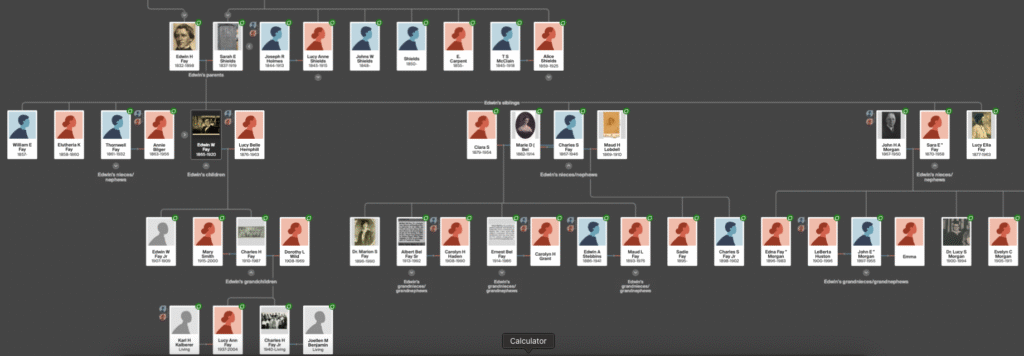
Dr. Edwin Whitfield Fay’s academic success is part of a larger family tradition that stretches two generations behind him, and at least one generation beyond him. Several immediate and extended Fay family members excelled in both academics and business. While none have any direct ties to W&L beyond E.W. Fay, we cannot help but point out the greatness within this extended family tree and marvel at their accomplishments.
In this edition, we’ll explore the career of Lucy Ella Fay (1877–1963), the woman whose mysterious mention in the Ring-tum Phi started it all.
We could dedicate even more space to the extended family: Edwin’s son, Charles Hemphill Fay (1910–1987) a noted theoretical physicist; his or brothers, Thornwell (1861–1932) and Charles Spencer Fay (1867–1946), who ventured into the railroad business in New Orleans and Texas; patriarchs, Edwin Hedge Fay (1832–1898) and Rev. Charles Hemphill (1852 –1932), Edwin Whitfield Fay’s father and father-in-law, respectively; Harcourt Morgan (1867–1950), Edwin’s brother-in-law; or nieces Dr. Marian Spencer Fay (1896–1990) and Dr. Lucy S. Morgan (1900–1994). Each achieved great success in their fields and within the academy, but for the sake of time, we’re narrowing our focus to Lucy and her contributions to the field of library science. Let’s dive in!
Lucy Ella Fay: (1877–1963), Librarian & Educator, sister of E.W. Fay
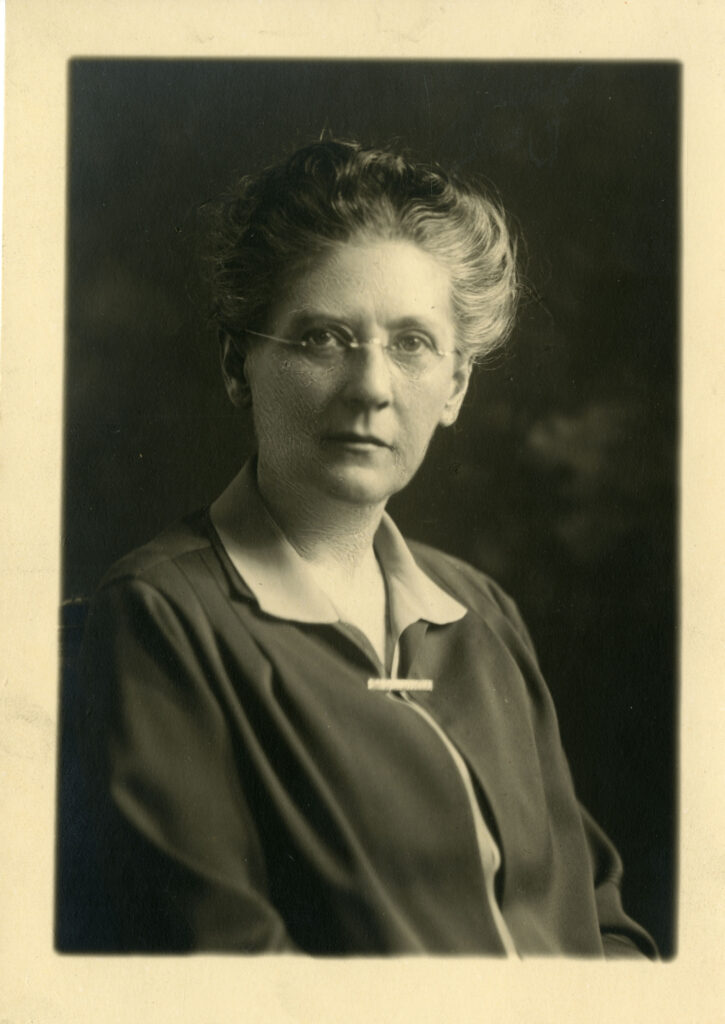
Lucy Ella Fay, courtesy of the University Archives, Rare Book & Manuscript Library, Columbia University Libraries (NYS Library School folder for Lucy E. Fay(Box 58, f.14)).
As one of the figures who started this deep dive, it’s only fitting that we begin this even deeper dive with Lucy Ella Fay. The youngest of the Fay siblings, Lucy’s career stops closely follow the locations of her elder siblings before branching out on her own to places farther afield.
Lucy received a B.A. from H. Sophie Newcomb Memorial College in New Orleans in 1895, which is now part of Tulane University. In 1886, Josephine Louise Newcomb (1816–1901) gave a substantial donation in memory of her daughter, Harriott Sophie Newcomb, for the creation of a “place that would go on year by year doing good.” Five years earlier, Josephine gave $20,000 to Washington and Lee University to erect Newcomb Hall as a memorial to her late husband. The 1885 gift and others made after she died in 1901 established the “first degree-granting coordinate college for women in the United States.”
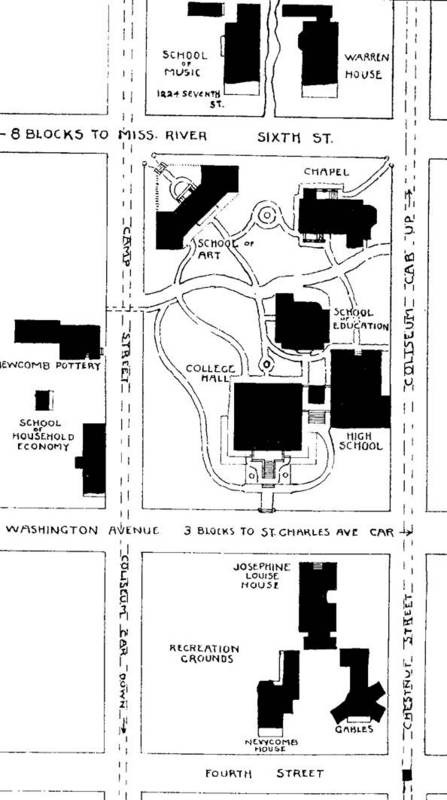
Lucy attended the second campus of Newcomb College, located in New Orleans’ Garden District, a property occupied by the college from 1890 until 1918. Lucy took the “doing good” to heart throughout the development of her career and dedicated herself to the training of library professionals and the documentation of major moments, including World War I.
Lucy was a frequent visitor to Baton Rouge, where her sister, Sallie (Sarah Elizabeth Fay Morgan, 1870–1958), lived with her husband, Harcourt Morgan, Professor of Entomology at LSU. Lucy also spent time in Lexington visiting her brother while he taught at Washington and Lee. She then followed Edwin to the University of Texas when he accepted a position as Professor of Latin in 1899.
Lucy graduated from the University of Texas at Austin in 1901 with her M.A. She completed additional degree training in Library Services at the New York State Library School in 1908 and in 1926 at Columbia University, where she also taught. The Columbia University School of Library Economy operated from 1887 until 1992 and was the first library school in the world. Shortly after its founding in 1887 by Melvil Dewey (1845–1931)– yes, that Dewey: king of the decimal. The school relocated from New York City to Albany in 1889, thereafter becoming the New York State Library School. It later merged with the Library School of the New York Public Library in 1926, making it part of Columbia University.
In between her studies, Lucy worked in her field as a university librarian and professor of English. First at the Texas State College for Women in Denton, Texas (1903–1906), then West Virginia University in Morgantown (1909–1910), then a long tenure at the University of Tennessee in Knoxville, soon after her brother-in-law, Harcourt, joined the faculty and later became President (1910–1918, and 1920–1923). Her time at the Texas State College for Women is notable as it aligns with the establishment of the college itself. Under the motto, “We learn to by doing,” the school was the first and only state college for women in Texas (it is still in operation today as Texas Woman’s University) and operated largely as a vocational school.
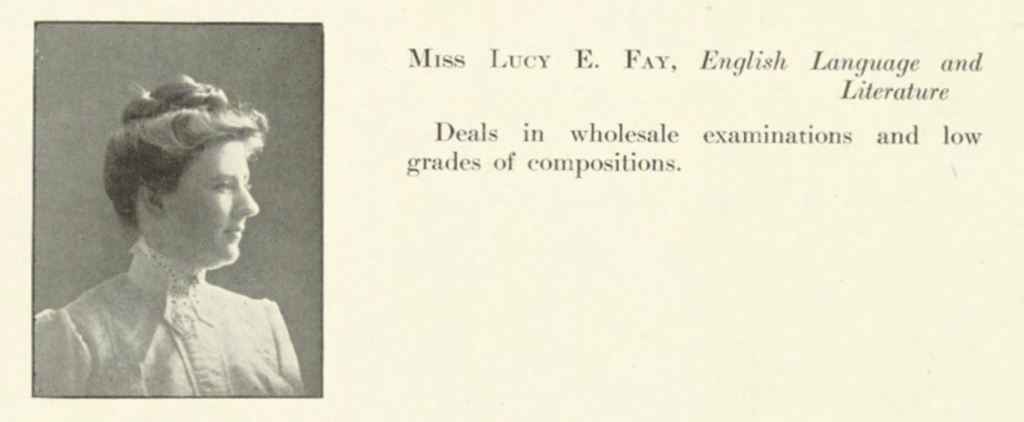
At the University of Tennessee, Lucy was a well- loved and respected member of the university staff. She coordinated a summer course in library methods for several years and held leadership positions within the state library association. She remained at UT as the university librarian for a total of eleven years, with a gap in her service between 1918 and 1920 when she devoted herself to a particular type of war work during World War I.

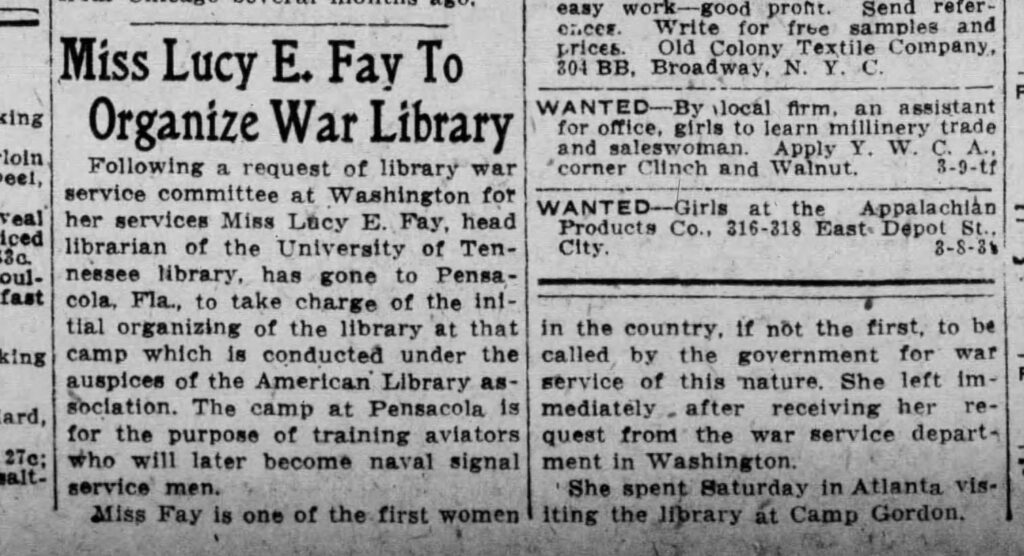
Lucy spent about three years as a volunteer librarian at the Naval Air Station Pensacola. The American Library Association deployed librarians to military installations to develop library services in support of troop morale and education. The Library War Service’s initial campaign raised more than one million dollars to provide periodicals and books to service personnel; Lucy was one of more than 1,200 library professionals who served in the program during World War I.
Following the war, Lucy returned to the University of Tennessee. In 1920, Lucy’s work took her to a temporary appointment in Pittsburgh as an instructor at the Carnegie Library School.
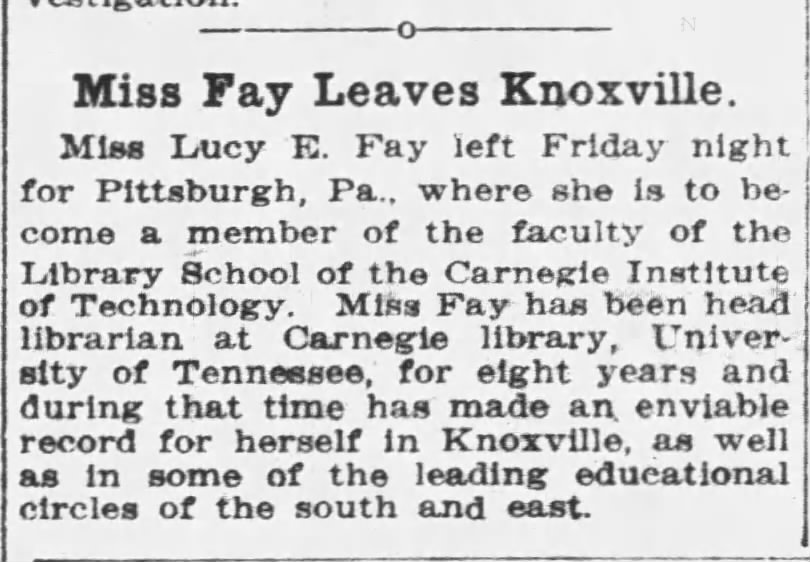

There, her brother Edwin died of lobar pneumonia while visiting. She then returned to the New York State Library School to further her studies. Lucy remained in New York following her graduation from Columbia University in 1926, becoming a professor of bibliography and publishing several books and articles on the use and purpose of libraries.
Lucy appears in the 1930 Federal Census as an Associate Professor at Columbia, listed as a “roomer” or boarder in an apartment at 620 W. 115th Street (a quick look at Google Maps shows this address is just blocks from Columbia University, though her building no longer stands). There she shared an apartment with Catherine Rebman (1870–1945) and Columbia Library Associate Director, Edna M. Sanderson (1876–1956).

Lucy’s leadership extended to the national level with several committee positions, including in 1939–1940, when she served as Chair of the ALA’s College Libraries Section. Lucy’s publications include Instruction in the Use of Books and Libraries (1928), which she piloted in 1915 with Anne T. Eaton (1881-1971), and revised many times over her career. She is also remembered for the Syllabus for the Study of the Bibliographical Method (1940).
By 1950, Lucy retired and lived in Philadelphia, Pennsylvania, with her niece, Dr. Marion Spencer Fay (1896–1990), who was then the Dean of the Women’s Medical College of Pennsylvania. Lucy co-edited a book of her father’s Civil War letters, This Infernal War: The Confederate Letters of Edwin H. Fay, in 1958.
Lucy died in 1963 in Chapel Hill, North Carolina, and was buried in Knoxville near her sister, Sallie.
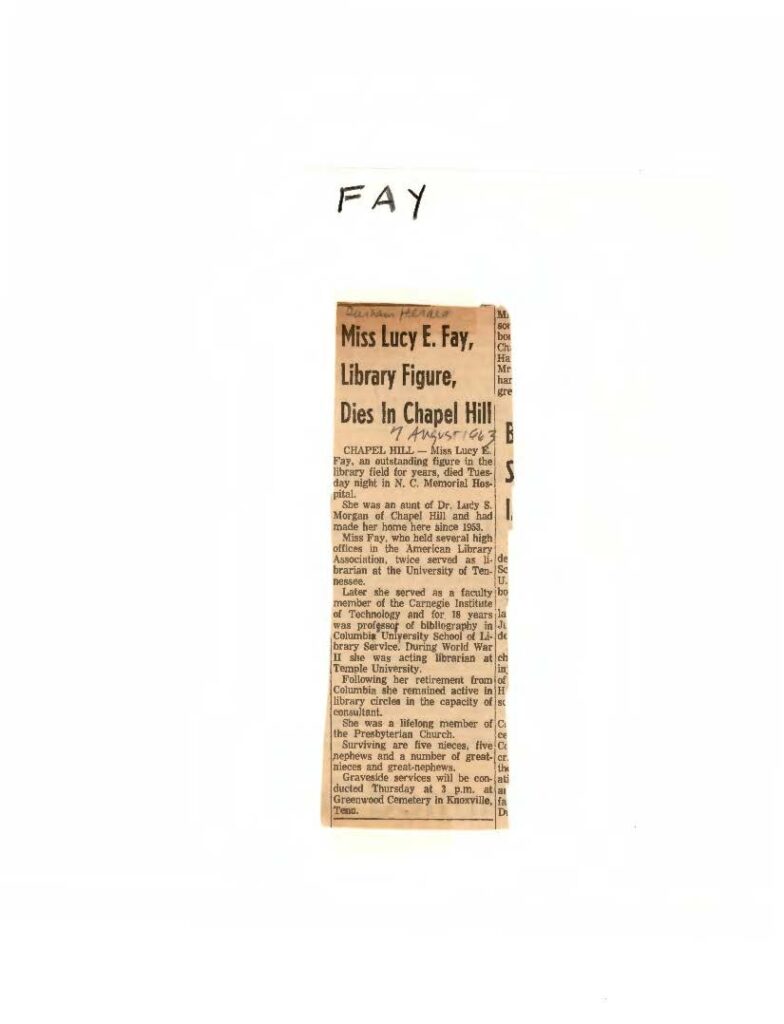
Courtesy of the University Archives, Rare Book & Manuscript Library, Columbia University Libraries
Comments are closed, but trackbacks and pingbacks are open.