
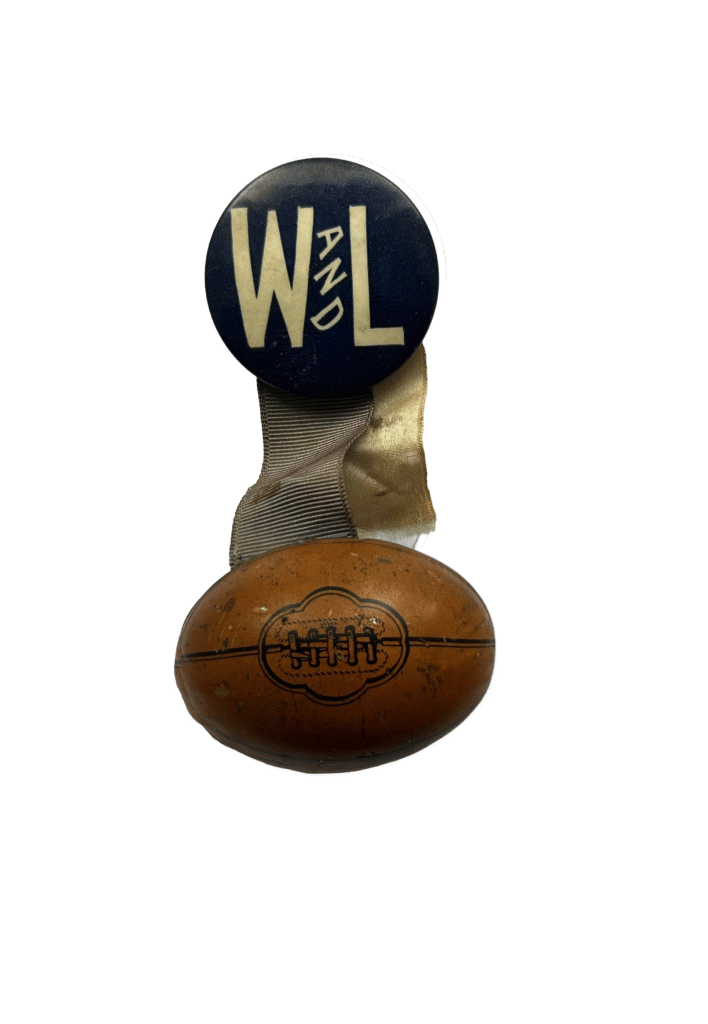
From pennants to t-shirts, spirit beads, and headgear, we show our school spirit through various garb. Odds are that every Washington and Lee student, past and present, has represented their favorite athletic team in some way during their time at W&L. Washington and Lee football has an official record dating back to 1890. Still, the school played unofficial games as early as the 1870s. While this new addition to the IHMG collection doesn’t date that far back, it is a rare piece of fan memorabilia that tells a much broader story in our nation’s history.
Dating to the late 1930s, this football pin signaled W&L pride. Football pins such as this were commonly worn by students, alumni, and fans of all ages. The ribbon and button are specific to Washington and Lee—bearing the university’s name and colors—while the tin football charm was a mass-produced emblem used on similar ribbons across collegiate football spirit wear.
The football is made from tinplate: a thin sheet of steel coated with a layer of tin. Tinplate is still used today, perfect for packaging food, beverages, and aerosol products. Tinplate is lightweight, inexpensive, and easily customized. The tin coating also prevented rust, which is why this pin and others like it have survived for decades.
The dangling football was decorated by means of lithographic printing, a process in which designs were printed directly onto the metal surface. This method allowed for fine details to appear clearly and made objects—especially toys and novelties—quick to produce.
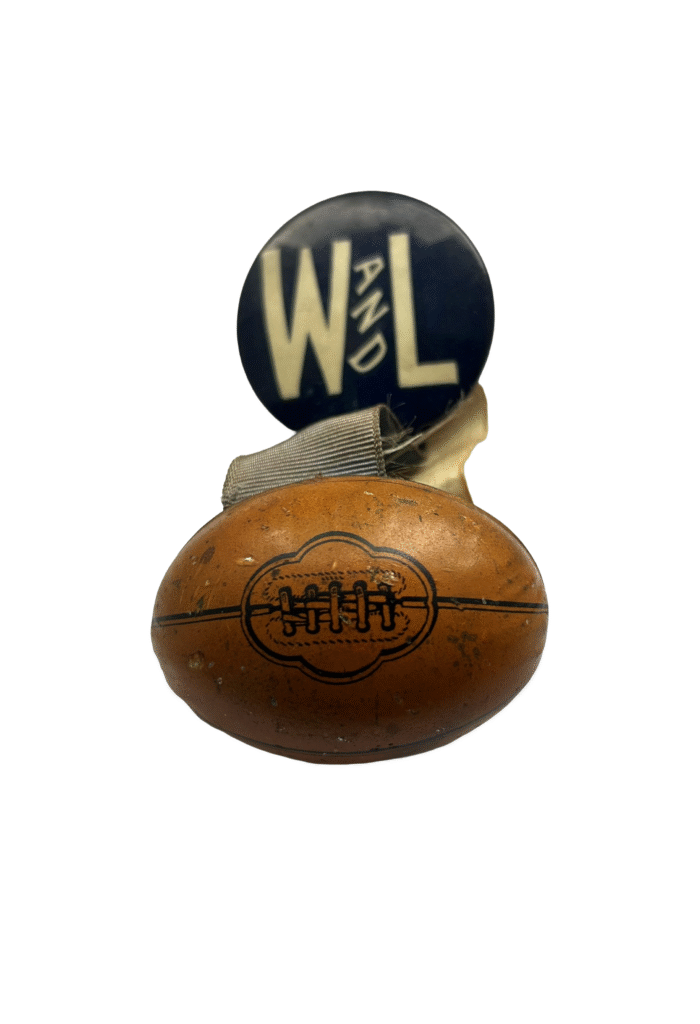
This pin would have appeared in many Washington and Lee fans’ wardrobes from the early 1930s to 1942. In that era, the Generals compiled a record of 41–70–10.
After the 1942 season, the university’s football program was temporarily suspended for the duration of the war. According to the 1943 edition of The Calyx, “The loss to Maryland marked the final appearance of a Washington and Lee football team on a college gridiron for the duration of the war. Early in December, the Athletic Committee, with the approval of the Executive Committee of the Board of Trustees, decided to “discontinue the sport until the war is won, thus abandoning the battles on the playing field for a greater fight.”
The Generals finished the season 1-8. Regardless, that same issue of The Calyx reported that “despite the team ‘s record, all observers agreed that this was the most spirited team that Washington and Lee has seen in many years.”

Many organizations and sports teams saw modified activity due to the war. The college faced a decrease in both enrollment and retention of students during the war, as noted in The Calyx that 1943 “began with an enrollment some 300 students fewer than normal and ended with scarcely 300 enrolled.”
An unknown number of students left the college that year, many of whom were recruited in October of 1942 by the Army, the Navy, the Marines, the Army Air Corps, or the Navy Air Corps (note the Air Force did not exist until 1947). The Calyx ceased publication starting in 1943, but when it returned after the war in 1947, it recognized the classes of 1943 (28 students), 1944 (29 students), and 1945 (8 students), as well as the drastically larger classes of 1946 (59 students) and 1947 (153). This increase in enrollment after the war was in part due to the establishment of the G.I. Bill in 1944, which provided financial support for veterans to attend college.
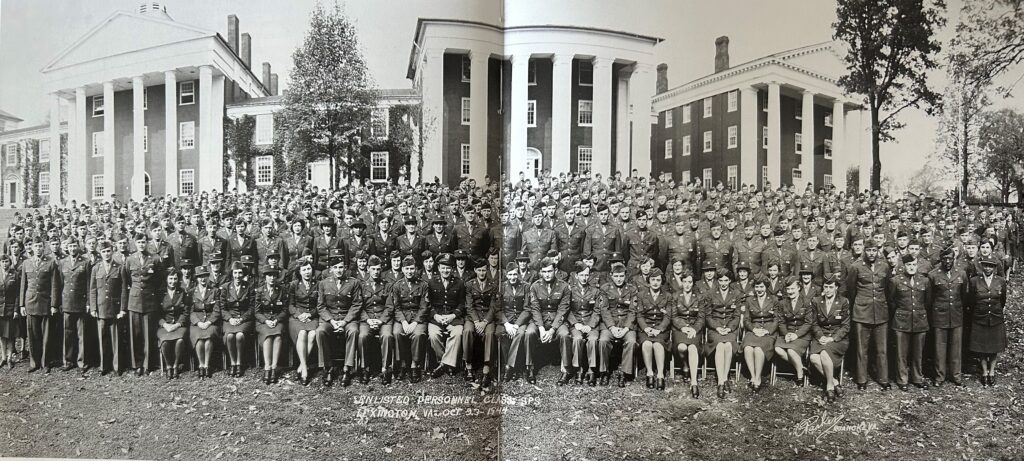
Even with the lack of weekly football games during the war, all was not quiet here in Lexington. During WWII, Washington and Lee University hosted the U.S. Army’s School for Special Services (later known as the “Army School for Special and Morale Services” and “The Army School for Personnel Services”). 22,000 men and women completed the program during its four-year period, learning ways to increase the morale of soldiers fighting in the war through recreation.
Let’s return to our football pin. Before World War II, many small tin novelties were imported from Germany, particularly from Nuremberg, which was a global center of tin lithography. When the United States entered the war, imports ceased, and American manufacturers—especially those in New England—expanded domestic lithographic production. Wartime metal rationing further limited the use of tin, and by the late 1940s, similar charms were instead made from plastic or celluloid. Due to this shift in the manufacturing process, we know that this particular addition to our collection most likely pre-dates the war.
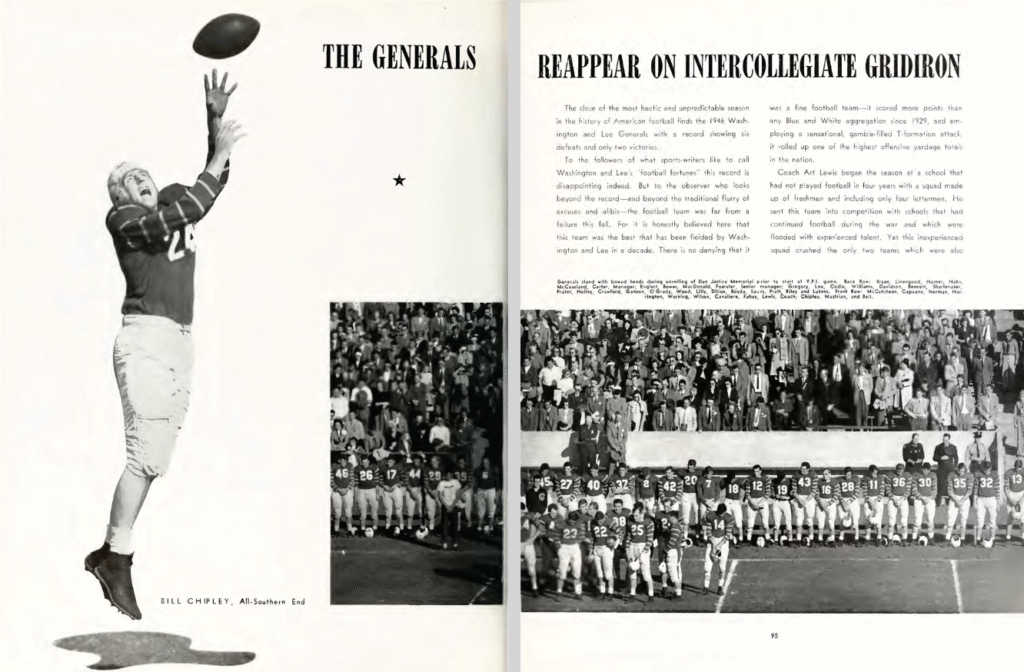
Upon the return to the field in 1946, the Generals went 2-6. That school year, The Calyx returned, stating: “To the followers of what sports writers like to call Washington and Lee’s ‘football fortunes’ this record is disappointing indeed. But to the observer who looks beyond the record—and beyond the traditional flurry of excuses and alibis—the football team was far from a failure this fall. For it is honestly believed here that this team was the best that has been fielded by Washington and Lee in a decade,” noting that the “Big blue team scores often but not enough.” The team scored a total of 118 points that season, starting with a 41-0 win against Hampden-Sydney.
It wasn’t until 1954 that WLU Football took another season off (that is a story for another day!). We look forward to seeing the WLU spirit at all athletic events this year as we cheer on the Generals. And as you do, consider what else your spirit wear may represent in the decades to come.
Comments are closed, but trackbacks and pingbacks are open.