
Last updated on June 2, 2026

Although the University Chapel was not constructed until 1868 and the Lee Family Mausoleum was not completed until 1883, the remains of a colorful Patriot of the American Revolution, Major General Henry “Light-Horse Harry” Lee III (1756–1818), lie within it.
A native Virginian, politician, and military officer, Lee’s rise and fall from public grace could be the plot of a soap opera. “Light-Horse Harry’s” reinterment in the Lee Family Mausoleum in 1913 is one of several that have occurred on campus. In a series we’re calling Reinterred and Reinterpreted, we will take a closer look at the lives of some of these individuals, their connections to W&L, and the stories of their reburial.
Note: We often refer to him as Henry III throughout this article to distinguish him from other relatives.
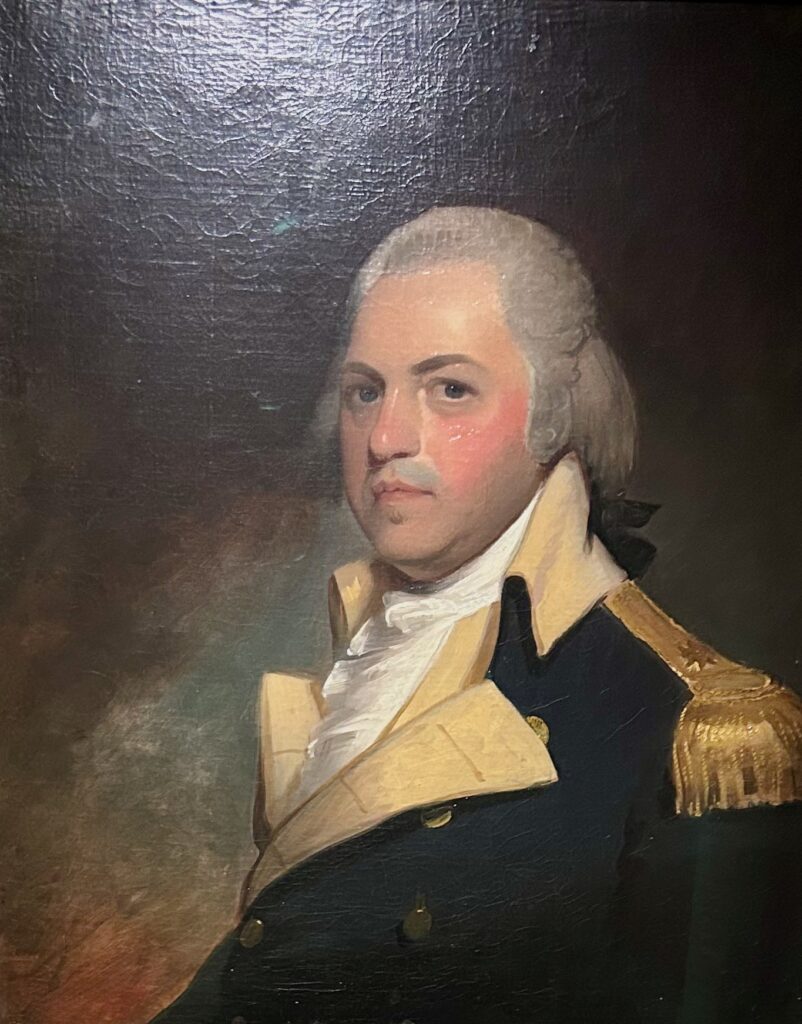
A native of Virginia, Henry III was educated at the College of New Jersey (modern-day Princeton) from 1770 until 1773.
In early adulthood, he distinguished himself as a cavalry officer and served in the American Revolution under Generals George Washington (1732–1799) and Nathanael Greene (1742–1786).
About the Image: Henry “Light-Horse Harry” Lee, William Edward West, after Gilbert Stuart, c. 1838, University Collections, gift of Mrs. A. Smith Bowman and Robert E. Lee IV, in honor of Captain Robert C. Peniston on his retirement from Lee Chapel.
Ambitious to a fault, Lee held several public offices, including as a representative from Virginia to the Confederation Congress (1786–1788), member of the Virginia House of Delegates (1789–1791), 9th Governor of Virginia (1791–1794), and member of the U.S. House of Representatives (1799–1801).
While he achieved in the political realm, his personal life and financial stability suffered. Historians describe his business acumen as “disastrous,” with multiple failed land deals and habitual financial mismanagement that eventually caused his flight from Virginia to escape creditors.
Family
Henry Lee III was the eldest son of Col. Henry Lee II (1730–1787) and Lucy Ludwell Grymes (1734–1792) and had seven siblings. The family lived at Leesylvania, a plantation in Prince William County overlooking the Potomac River, which produced tobacco, corn, wheat, and dairy products using the enslaved labor of more than 50 Black people. Historian Paul C. Nagel, author of The Lees of Virginia, noted that the siblings, apart from Richard Bland Lee (1761–1827), remained distant from their well-known brother, Henry III, throughout his life and career.
The family patriarch, Henry II, died in 1787 and willed Leesylvania to his wife Lucy and second son, Charles, excluding Henry III, which historians attribute to Henry’s demonstrated financial irresponsibility. Nagel describes Henry III as “a compulsive speculator in real estate and other get-rich-quick schemes.”


Henry III married twice, both to women from well-established Virginian families. His first wife was his second cousin, Matilda Ludwell Lee (1764–1790). Following her death, Henry then married Anne Hill Carter (1773–1829).
As her father’s oldest surviving child, Matilda Ludwell Lee inherited the majority interest in her family plantation, Stratford (i.e., Stratford Hall), the ancestral home of the Lees of Virginia. No portraits of Matilda survive, but her contemporaries described her as “divine.” When they married, Matilda was 16 years old, and Henry was 10 years her senior. By accounts, their marriage was a happy one. They lived in Virginia, except for a brief stint in New York during Henry’s tenure in the House of Representatives. Of their four children, two survived: Lucy Grymes Lee and Henry “Dark Horse Harry” Lee IV (the last Lee to own Stratford).

At Stratford, Henry III took over management of the plantation and its assets with limited success. Despite securing wealth and status via marriage, his risky financial investments threatened their stability. He ran up incredible debts by buying large tracts of land, borrowing large sums of money, and speculating in schemes that proved to be financially unsuccessful.
Throughout this financial turmoil, Matilda was in poor health. Not long before her death, she placed the fate of Stratford Hall and its assets not in the care of her husband, but in a trust for her three children. Her cousin, Ludwell Lee, and brother-in-law Richard Bland Lee were named as managers of the trust until her children came of age. Mildren died at the age of 26 in 1790.
“…by the time of Matilda’s death, Harry had lost her confidence and that of most other members of the Lee family…. Harry was denied ownership of Stratford. During her last moments, Matilda directed that a deed of trust be drawn, putting Stratford and her other properties in the hands of cousins Ludwell Lee and Richard Bland Lee until her children came of age. By now, there were three heirs: Philip, Lucy, and Henry [IV].
The Lees of Virginia, pg. 165
Harry was treated courteously and allowed to continue living at Stratford with his offspring. This generosity was probably a mistake, especially since one of the two trustees was Harry’s compliant younger brother, Richard.
Whenever a chance appeared, Harry found ways to chip at the property, so that an even smaller amount of land surrounded the great house when the estate passed in 1808 to Matilda and Harry’s son, Henry, who earlier had become the heir at the death of his elder brother Philip. These parcels of Stratford had been sacrificed to Henry’s mounting indebtedness from speculative land ventures.”
In 1793, three years after Matilda’s death, Henry remarried Anne Hill Carter of Shirley Plantation. Anne’s father, likely well-aware of Henry’s financial insufficiencies, placed his daughter’s inheritance in a trust as well, “free from the claim, demand, let, hindrance, or molestation of her husband, General Lee, or his creditors directly or indirectly.”
Five of Henry and Anne’s children survived to adulthood, and four of those were born at Stratford, including Robert Edward Lee (1807–1870). Often away from the plantation in pursuit of his business ventures, the house and land fell into disrepair. With the instability created by Henry III’s mismanagement and Henry IV’s scandalous personal life, the Lees lost Stratford Hall in the 1820s.

In total, Henry III was father to ten children:
| With Matilda | With Anne |
| 1. Nathanael Greene Lee (1784–1784) 2. Philip Ludwell Lee (1784–1794) 3. Lucy Grymes Lee (1786–1860) 4. Henry Lee IV (May 28, 1787 – January 30, 1837) | 5. Algernon Sidney Lee (1795 –1796) 6. Charles Carter Lee (1798–1871) 7.Anne Kinloch Lee (1800–1864) 8.Sydney Smith Lee (1802–1869) 9. Robert Edward Lee (1807 –1870) 10.Catherine Mildred Lee (1811–1856) |
Military:
Henry III joined the Revolution early after the outbreak of war, becoming part of a dragoon (elite, mounted infantry soldiers) attachment of the 1st Continental Light Dragoons in Williamsburg, Virginia, in June 1776. He was commissioned as a captain by Governor Patrick Henry [dates]. The regiment was in Philadelphia in 1777, and by 1778, Henry was promoted to major. During this time, he developed a close relationship with George Washington, which would help both his career and personal life in decades to come. Lee’s leadership at the Battle of Paulus Hook in New Jersey (August 1776) on a raid on a British fort was his first brush with notoriety. The raid killed 50 British soldiers and captured another 158.
Some of his fellow officers brought him up on court-martial for his actions, of which George Washington disapproved. He was acquitted on all charges. He received a gold medal from the Continental Congress in 1779 for his leadership at Paulus Hook, an honor given to only six others. He leveraged several successful missions and his relationship with Washington to earn his own command, a mixed corps of cavalry and infantrymen called Lee’s Legion by November 1780. As leader of Lee’s Legion (also known as the 2nd Partisan Corps), he gained a reputation for success and savvy, with effectiveness at reconnaissance, disruption of enemy supply lines, and expeditions behind enemy lines – all tactics now known as guerrilla warfare.
To John Jay
Letter from George Washington to John Jay about Harry Lee III, 1779
Head Quarters West Point August 23d 1779
Sir,
I have the honor to inclose your Excellency Major Lee’s report of the surprise & capture of the Garrison of Powles Hook. The Major displayed a remarkable degree of prudence address enterprise and bravery upon this occasion—which does the highest honor to himself and to all the officers and men under his command. The situation of the Post rendered the attempt critical and the success brilliant: It was made in consequence of information that the garrison was in a state of negligent security, which the event has justified.
I am much indebted to Major Genl Lord Stirling for the judicious measures he took to forward the enterprise, and to secure the retreat of the party.
Lieut. McCalester who will have the honor of delivering these dispatches, will present Congress with the standard of the garrison which fell into his possession during the attack. Major Lee speaks of this Gentlemans conduct in the handsomest terms. I have the honor to be With perfect respect and esteem
Your Excellency’s Most Obet servant
Go: Washington
P.s. The report not having been received till this day prevented a speedier transmission. Major Lee mentions twenty men lost on our side—Capt. Rudulph informs that since the report was concluded several of the missing had returned which will lessen the supposed loss near one half.
Lee’s Legion was primarily based in the southern theater of the war at the request of General Nathanael Greene, and protected South Carolina by intimidating Loyalists and harassing British expeditions. It was during this time that Henry III earned his nickname, “Light-Horse Harry,” for his horsemanship. In 1783, the Legion saw action at the Battle of Guilford Courthouse, alongside his friend and mentor General Greene, in North Carolina, before helping retake South Carolina. After the stalemate at the Battle of Eutaw Springs in 1781, Lee and Greene had a falling out; one of many Lee had with his peers and superiors. Reassigned to Washington’s command, Lee arrived at Yorktown in time for the British surrender; after which, Lee resigned from his commission in 1782.
Business & Political Life:
Henry leveraged his military career into a political career. A Federalist, Lee held several public offices, including as a representative from Virginia to the Confederation Congress (1786–1788), member of the Virginia House of Delegates (1789–1791), 9th Governor of Virginia (1791–1794), and member of the U.S. House of Representatives (1799–1801). Another of Lee’s failed schemes occurred when he sought to capitalize on Washington’s plans to make the Potomac River navigable through the construction of a canal system.
The Potomac Canal was constructed between 1785 and 1802 and was operational by 1802. Ever ambitious, Henry III invested in several ventures associated with the project. He even attempted to sell some of his interest in the project to Thomas Jefferson (1743–1826) in 1789. In 1790, the same year that Matilda died, he named one of the towns that grew around the project, Matildaville, for her, and placed upon the town a hope for great profit. Plagued by constant financial challenges, the project had a major labor problem. Relying on both rented enslaved labor and indentured servitude, the project succumbed to bankruptcy in 1828, a decade after Henry’s death and long after his association with the company was severed.
Matildaville’s fate was tied so closely to the canal project and the Company that it was eventually abandoned. The ruins of the company town are part of the Great Falls Park, owned and managed by the National Park Service.
Henry III served as Governor of Virginia for three consecutive one-year terms between 1791 and 1794. He briefly returned to military action in 1794, while governor, when called upon by President Washington to lead a militia force in putting down the Whiskey Rebellion. Lee supported Federalist policies in his time in public office. In 1799, he was elected to the House of Representatives, and in that same year, the death of former President Washington further pushed Lee into the limelight when his eulogy went the 18th-century equivalent of viral. Congress commissioned Lee to write a eulogy for his friend and mentor:
…he was second to none in the humble and enduring scenes of private life; pious, just, humane, temperate, and sincere; uniform, dignified and commanding, his example was as edifying to all around him, as were the effects of that example lasting.
This now-famous memorial set the tone for future memorialization of American presidents but could not fully rehabilitate Lee’s public reputation. By the end of his term in the House of Representatives in 1801, Henry’s debts, political and personal feuds, and general temperament made him an unpopular public figure with few redeeming moments interspersed amongst the controversies.
His Last Years:
Henry’s debts landed him in jail in Westmoreland and Spotsylvania counties in 1809 and 1810. At this time, his children with second wife Anne ranged in age from about 14 to just two, and the youngest, Mildred, was not yet born. While in prison, he authored Memoirs of the War in the Southern Department of the United States, which was published in 1812. The two-volume book presented a self-aggrandizing account of his efforts during the Revolution and attacked his political enemy, Thomas Jefferson. The memoir was not a best seller and did little to help his debt. Bankrupt and free of prison, Lee suffered another blow – this time physically – which robbed him of his good health for the rest of his life. By this time, Anne and the children were forced to leave their home at Stratford Hall and resided in Alexandria, Virginia.
In July 1812, Lee traveled to Baltimore to join the defense of his friend, Alexander Conte Hanson (1786–1819), the editor of the Federal Republican newspaper, and a vocal critic of the War of 1812. A mob attacked the house where Lee and his compatriots were staying. The police moved the men to jail for their protection, but the mob attacked the jail; Lee suffered a severe beating, with a deep cut on his cheek caused by a pocketknife and damage to his eyes where attackers tried to gouge them. He survived but was incapacitated for life. Lee visited his family briefly in Alexandria but left to escape creditors and never returned.
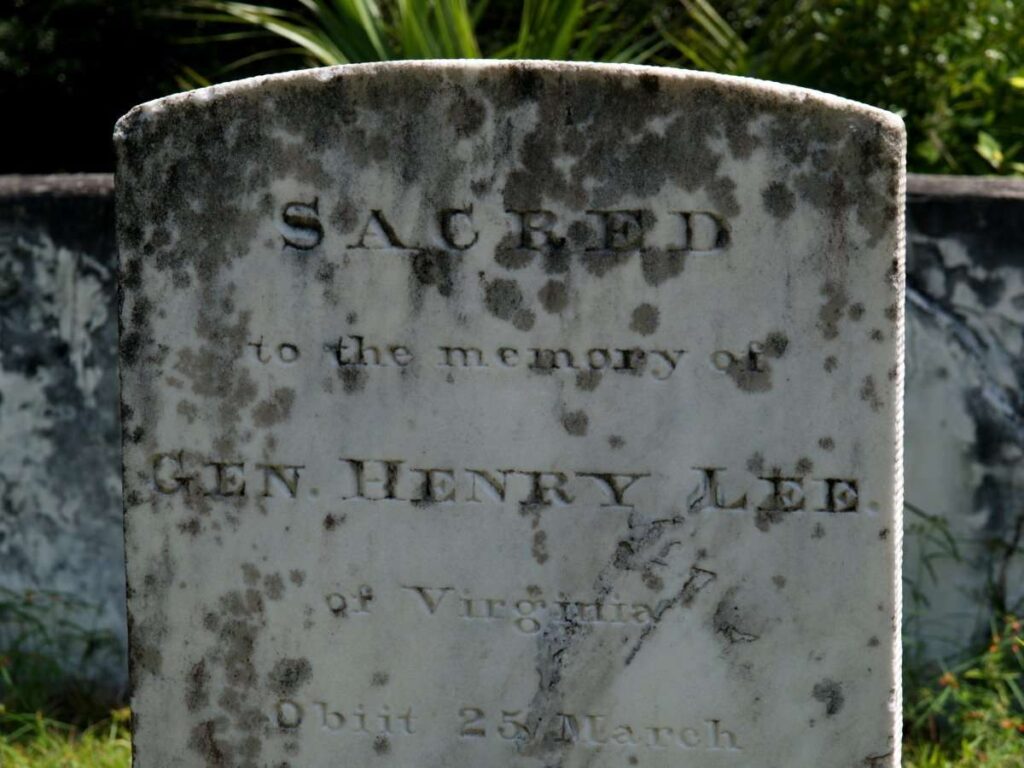
He traveled through the Caribbean for the next six years. In early 1818, Lee returned to the United States, landing at Cumberland Island, Georgia, “feeble, emaciated, and penniless.” There, he stayed with the daughter of General Nathanael Greene, Louisa Shaw (1785–1831). He died there on March 25, 1818, and was buried on the island. During his presidency of Washington College (known today as Washington and Lee University), Robert E. Lee visited his father’s grave in 1870, the second “meeting” of the two since 1812. Robert E. Lee first visited his father’s grave on Cumberland Island in 1862.
Reinterment:
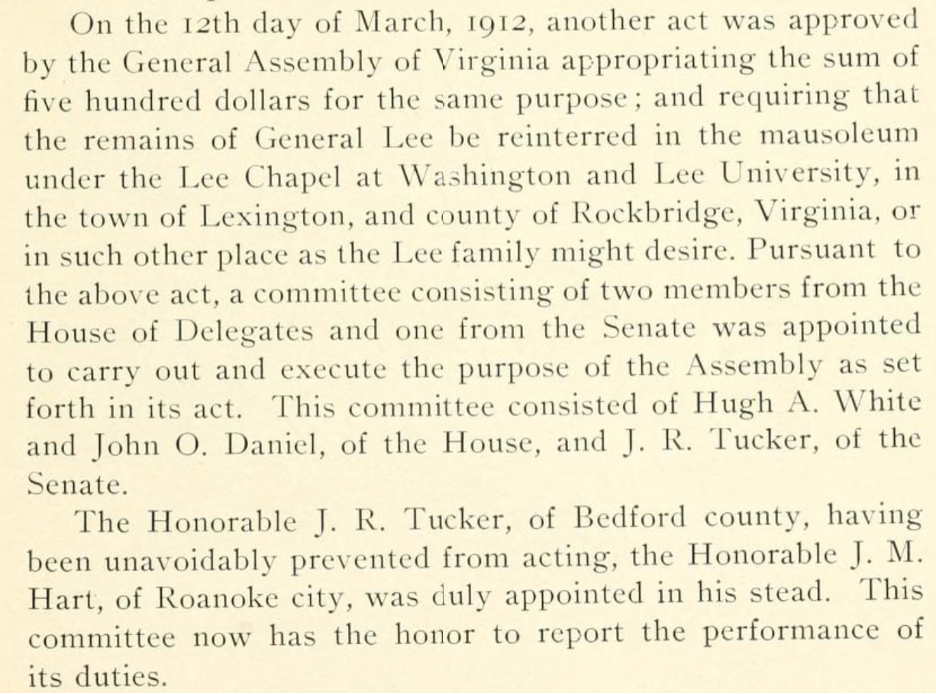
In 1913, the Virginia Assembly facilitated the exhumation and reburial of Lee’s remains in the mausoleum at Washington and Lee University’s Chapel. According to the report, state funds had been allocated in 1861 for the relocation of Lee’s remains, but the Civil War derailed those plans. Following a March 1912 report published by the state commission, the decision set in motion plans for the relocation. About $500 was allocated for the project, and delegates were assigned to oversee the task. The state of Georgia, as well as representatives from several Revolutionary hereditary societies, objected to the project, but once the surviving members of the Lee family weighed in, the project moved forward unprotested.
The remains of Henry “Light Horse Harry” Lee were placed in a crypt next to those of his son, Robert, in 1913, who, as the Encyclopedia of Virginia puts it, “…he barely knew in life.” His original headstone remains on Cumberland Island.
Further Reading:
Reminiscences of the last days, death and burial of General Henry Lee, 1870
Report of the Committee appointed under act of the General assembly approved March 12, 1912
The Stronghold: A Story of Historic Northern Neck of Virginia and Its People, by Mariam Haynie (1959)
The Lees of Virginia: Seven Generations of an American Family, by Paul C. Nagel, (1990)
Comments are closed, but trackbacks and pingbacks are open.