
Last updated on February 10, 2026
R. Edward Jackson
Inspired by the First Year Read Discussions held across campus in early September, we (the IHMG) dug into the digital archives for connections between The Great Gatsby and W&L over the last 100 years. We noticed that the novel and its flamboyant era have inspired multiple Fancy Dress Balls, including those held in 1990, 1998, and 2013, just to name a few. Ring-tum Phi editors and staff writers made frequent references to the novel and its author over the decades as it came to symbolize not only an era in American history, but a generation.
Appearing in print in the form of movie theatre ads dating to 1926 (film accompanied by the Southern Collegian Orchestra), 1949 (a scathing review of the most recent film adaptation by movie reviewers McKelway and Sibley), and more, F. Scott, Zelda, and Gatsby have resonated in a variety of ways for multiple generations of WLU students. Most striking was a May 5, 1943 editorial that critiqued the Gatsby generation, the parents of the then-students.
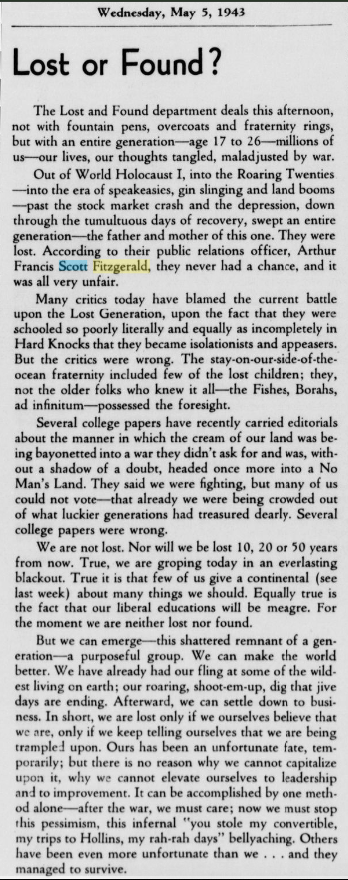
The author, presumably editor R. Edward Jackson, rejected his classmates’ classification as the “Lost Generation”- the millions of Americans aged 17 to 26– whose “lives, … thoughts, [were] maladjusted by war.” Instead, he asserts that the earlier generation, the Gatsby generation, who saw the transition from World War I into the Roaring Twenties, as the lost ones. Calling F. Scott Fitzgerald that generation’s public relations officer, he disagrees with the argument that they “never had a chance, and it was all very unfair,” instead placing the blame for the world’s current situation (World War II) firmly in the hands of the “older folks” and not the so-called Lost Generation.

Many critics today have blamed the current battle upon the Lost Generation, upon the fact that they were schooled so poorly literally and equally as incompletely in Hard Knocks that they became isolationists and appeasers. But the critics were wrong. They stay-on-our-side-of-the-ocean fraternity included few of the lost children; they, not the older folks who knew it all… possessed the foresight
In the editorial, Jackson encouraged his generation to instead emerge from the turmoil as a “purposeful group” who had the power to leave the world better than they had found it. “In short, we are lost only if we ourselves believe that we are being trampled upon… after the war, we must care; now we must stop this pessimism… this bellyaching. Others have been even more unfortunate than we… and they managed to survive.” The life that he led following this editorial shows that he truly walked the walk and used this mentality to formulate his life and career.
For context, full-time students at W&L in 1943 were growing scarce. Starting as early as the days and weeks following the attack on Pearl Harbor in early December 1941, students, faculty, and staff left campus in waves for war work, whether voluntarily or by draft. By the end of the sprint term in 1943, the Ring-Tum Phi suspended operations due to dwindling staff and redirected attention of the campus community in deference to the ongoing war. The campus soon became the site of the US Army Special Services School with a rotating cadre of classes, which included for the first time women and Black service members—shifting the day-to-day dynamic of the university.
Among those students leaving W&L for war service was editor Ed Jackson, more formally known on the masthead as R. Edward Jackson, author of the editorial that sparked our curiosity. In 1942-1943, amidst the constant fluctuations in student enrollment and waves of military enlistments and drafts, Jackson and two other students rotated responsibilities as editor of the paper.

Ed Jackson (1925-2010, W&L AB’45), a native of Mount Airy, North Carolina, enrolled in W&L for his first year in 1941-1942. As such, he was a student gathered around radios awaiting news following the attacks on Pearl Harbor and saw the ongoing campus adaptations. Jackson joined the Ring-tum Phi early in his W&L career, a carryover from his high school years, where he served two years as the editor of High Spots, the newspaper of Mount Airy High School.
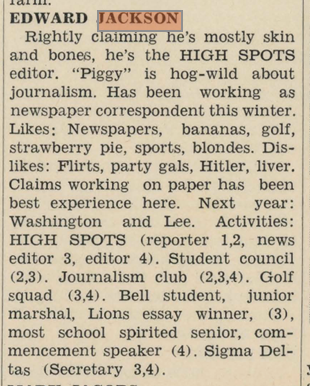
In piecing together primary sources of his college career, Jackson’s passion for journalism shone through. Amongst his many bylines and editorials as he climbed the newsroom ranks were several philosophical entries meant to encourage and inspire his classmates in uncertain times as well as updates on university operations amidst ongoing change (IHMG Note: one editorial we’ll revisit at a later date saw Jackson advocate for coeducation). In January 1943, Jackson and 10 others were initiated into Sigma Delta Chi, the professional journalism fraternity. That same month, Jackson and most of his fellow students sat for placement testing to sort them into the appropriate future assignments for military reserves; Jackson received the classification of V-1 in the Navy Reserves, which meant that following special training, he might be assigned to work aboard an aircraft carrier. For Jackson and most others at W&L, the countdown had begun on their time on campus.

Midyear departures forced by wartime conditions led the Publications Board to set up an organization unlike any in recent years. In spring 1943, the Board reached an agreement on the new system after a meeting to work out a plan to replace Editor Bill Talbott and Calyx Business Manager Lynch Christian, who were called by the Army Air Force. At this meeting, Desk Editor Dick Bartlebaugh, News Editor Ed Jackson, and Managing Editor Charles Rowe were assigned as editor for two issues each for the rest of the term. The April 1943 elections would name from this trio the regular 1943-44 editor, Jackson. The war again intervened, and Jackson never got to serve his elected year as one of three named editors because he was called to the Navy reserves in early summer 1943 along with nearly 130 other current W&L students. Bringing us back around to the editorial that started it all, we revisit Jackson’s May 5, 1943 rejection of generational scapegoating. At the time this editorial appeared, Jackson likely had a strong inkling, or outright knowledge, that his time as a “college man” was over, at least for the time being.
From the summer of 1943 through the end of the war, Jackson was a communications and deck officer aboard the US attack transport Cleburne, achieving the rank of junior lieutenant at the time of his discharge. Jackson returned to W&L for the 1946-1947 academic year to complete credits needed for graduation. He rejoined the Ring-Tum Phi as Advisory Editor and Columnist. His debut column, “Postwar Primer”, offered “grandfatherly advice” to new and returning students, of whom he estimated 80% were veterans. Jackson completed his studies and graduated cum laude before moving on to employment with United Press in New York—the continuation of a long and successful career in journalism.
Updates in the W&L Alumni Magazine help piece together Jackson’s illustrious career with changes in assignment, country, and company noted as a part of the alumni updates and feature articles. Jackson worked for United Press for more than three decades, including a tenure at the London Bureau in February 1950 as a specialist reporting European reaction to events in Korea and the far East, and later as the Rome Bureau Chief beginning in December 1953. He joined Time magazine in 1957, serving as a foreign news writer and News Editor. He returned to Rome in 1963 for Time, where he supervised coverage of the death of Pope John and the election of Pope Paul, both of which were cover stories; the Italian elections and yearlong political crises; two Greek elections and the death of King Paul; also directed Time’s color photo and word coverage of the Pope’s trip to the Holy Land. In 1968, he became Deputy Chief of Correspondents of Time magazine.
The July 1981 Alumni Magazine notes that R. Edward Jackson became the managing editor of the Washington Star. Further adding that “Jackson worked in the news business for 34 years, 10 years with United Press in London, Rome, and New York, and 24 years with Time magazine as a contributing editor, Rome bureau chief, deputy chief of correspondents, international editor and Washington news editor. He became editor of the Time-Life News Service at the Star in October 1980 and was promoted to managing editor in April 1981.” The updates also note personal milestones in Jackson’s life including his first marriage to Christina Margaret Reid in 1947, the birth of his two sons while assigned to the London Bureau, and his life with second wife, Kathleen, who worked alongside him at Time-Life.
In his later years, Jackson funded the Edward Jackson International Reporting Fund at W&L to support student journalism opportunities abroad. In 1995, he was inducted into the North Carolina Journalism Hall of Fame. Upon his death in 2010, his obituary lauded his more than 40-year career and impact on his fellow journalists throughout his career.
He held leadership posts in the Overseas Press Club and the Correspondents Fund, and endowed journalism scholarships at Washington & Lee, UNC-Chapel Hill, and UC-Berkeley. He had a keen mind and boundless curiosity, traveled widely, loved good food and talk, followed sports avidly, and was an astute student of politics and the media. To his family, he was above all an engaged, generous, and supportive husband, father, father-in-law, and grandfather.
Like his classmates and others of his generation, Jackson’s keen sense of duty and love for W&L have impacted the lives and careers of many who followed. In his own words, his generation was “… not lost…” instead, in the face of great adversity and challenge, they emerged as a “purposeful group” who tried their best to “make the world better.”

Sources
- May 5, 1943 Ring-Tum Phi, “Lost or Found?”
- May 24, 1941– High School senior newspaper
- January 22, 1943: Ed Jackson was initiated into Sigma Delta Chi, the professional journalism fraternity, alongside 10 other men. On Page 2, listed as Desk Editor
January 29, 1943- News Editor; “Faculty Heads List Students Qualifying for Service Reserves”… Naval Reserve… V-1…Ed Jackson
- February 5, 1943: News Editor; Reservists will be called…
- February 24, 1943: Forced by wartime conditions to set up an organization unlike any in recent years, the Publications Board has named Wallace E. Clayton as supervising editor of the Ring-tum Phi and James LaPlante as business manager of the Calyx, subject to supervision of a special board committee. Agreement on the new system was reached at last week’s publications group session, which met to work out a plan for replacing Editor Bill Talbott and Calyx Business Manager Lynch Christian, who were called by the Army Air Force… Desk Editor Dick Bartlebaugh, News Editor Ed Jackson, and Managing Editor Charles Rowe will serve as editor for two issues each and Clayton will be acting editor of the final issue. From this trio will come the regular 1943-44 editor to be named in the annual April elections after this trial period.
- March 1943: Editorial, ‘Exhibit A’
- March 25, 1943: V-1 students unassigned
- May 19, 1943– editor; credited author of article about “Year 1943”… “Year 1943 Was Tumultuous, Changing One for W&L; This School in Its Own Eyes was Hardest Hit of All; Arrival of Army Unit Brought War to Front Doorstep” – school year 1942-1943; last published Ring Tum Phi until after World War II (resumed printing in 1946; interim newspaper was The Columns)
- Mount Airy News, Obituary
Biographical Sketch:
Robert Edward “Ed” Jackson, known professionally as R. Edward Jackson, had a more than 40-year career in professional journalism following his graduation from Washington and Lee University. Jackson was the son of Annie Britton and Robert Reid Jackson and was born January 25, 1925, in Mount Airy, North Carolina. Jackson’s father was co-owner of Jackson Bros. department store. According to a 2010 obituary, Ed Jackson ran a neighborhood newspaper with a. circulation of 200 at the age of twelve, worked as a stringer for the Winston-Salem Journal in his teens, and edited the school paper at Mount Airy High School. At W&L, Jackson was a reporter, columnist, and editor as well as member of Sigma Delta Chi professional journalism fraternity and Kappa Alpha Psi social fraternity among other campus philanthropic and volunteer activities. Enrolled in the class of 1945, Jackson left W&L to join the Navy reserves in summer 1943 and returned in 1946 to complete his degree in history after nearly two years of military service. In the Navy, Jackson served as a deck communications officer aboard the USS Cleburne, and reached the rank of junior lieutenant. Following graduation, Jackson departed for New York and a career with the United Press that saw his posting in the London Bureau and Rome bureau. In 1957, Jackson joined Time magazine, eventually holding several leadership positions within the Time-Life Inc. corporation.
Jackson began his career with United Press before moving on to Time where he spent the bulk of his career in various leadership positions including as the Rome bureau head and Deputy Chief of Correspondents. He retired from Time-Life in 1985 and embarked on stint as the editor in chief of the World Press Review. Throughout his career Jackson was involved with many journalism societies including the Overseas Press Club. Later, Jackson endowed journalism scholarships at UNC-Chapel Hill, UC-Berkley, and of course, Washington and Lee University, to further the careers of young journalists. Jackson shared two sons with his first wife, Margaret Reid- Roger Jackson and Blair Jackson- and was survived by his wife of more than thirty years, Kathleen Beakley, at his passing in 2010. W&L continues to use the Edward Jackson International Reporting Fund to support the students on campus and abroad.
Professional Timeline:
- 1947-1957: United Press
- 1947 Joined UPI as a foreign news writer
- 1950-1953: UPI London bureau
- 1953-1956: UPI Rome bureau head
- 1957-1986: Time magazine and Time-Life Inc.
- 1957: Joined Time magazine as a writer
- 1959-1962: Time foreign news desk editor
- 1963-1965: Time Rome bureau chief
- coordinated Time coverage of the Second Vatican Council, the death of Pope John XXIII and the election of Paul VI, and Paul VIs unprecedented visit to Israel.
- 1966-1972: Time Deputy Chief of Correspondents
- 1972-1975: Editor of International Editions
- headed the team that developed editions of Time geared specifically to readers in Europe, Asia, and Australia, and served as the international editions first editor.
- 1976-1980: Washington news editor
- ran the magazines coverage of the Republican and Democratic conventions of 1976 and 1980
- 1980-1981: managing editor of Time-owned Washington Star (appointed managing editor just months before Time folded the newspaper, bringing its 129-year record of continuous publication to a close)
- 1985: retired from Time
- 1986-1991: editor-in-chief of World Press Review, a New York-based monthly digest of selections from newspapers outside the United States
Further Reading/ Primary Source Timeline
- October 13, 1942: byline “Vacation Plans Still in Question”; Charity Chest article, “Drive to Continue Until Every Student is Contacted Once” Ed Jackson cited as running publicity for campaign; listed as Desk Editor; byline “Former Ring-tum Phi Sports Editor Wins Fame as Marine Combat Correspondent”
- January 22, 1943– Sigma Delta Chi Initiation
- February 2, 1943– News Editor
- March 3, 1943: News editor; byline “Opinations”- future of W&L after the war and argued for coeducation
- March 10, 1943: News editor; “Exhibit A”
- March 25, 1943– V7 reservists at school asked to leave early and report to Columbia for training (Jackson not among them as V1)
- April 14, 1943- “well done” article complimenting Jackson and two other students who have rotated responsibilities as editor of Ring-Tum Phi during challenging academic year due to war
- April 21, 1943- R. Edward Jackson listed as one of three editors, “Per Usual”
- April 28, 1943: editorial “Frankly my dear”
- May 5, 1943– editorial & listed as editor
- May 19, 1943– editor; credited author of article about “Year 1943”… “Year 1943 Was Tumultuous, Changing One for W&L; This School in Its Own Eyes was Hardest Hit of All; Arrival of Army Unit Brought War to Front Doorstep” – school year 1942-1943; last published Ring Tum Phi until after World War II (resumed printing in 1946; interim newspaper was The Columns)
- May 1943 Alumni Magazine: Ed Jackson listed as one of 4 Ring Tum Phi editors in description of 1942-1943 academic year
- Ring-tum Phi, January 9, 1992: 1943-1946 departed for War according to 1992 article and returned in 1946
- September 20, 1946: Advisory Editor & Columnist; byline “Postwar Primer”
- November 22, 1946:
- May 3, 1947: byline “Independents Vote 11-Fraternity Ticket Making Them Victorious In Every Race; 1044 Voters Set W&L Polling Record”; byline “Campus Serene; Madhouse Over”; listed as Advisory Editor
- September 1947 Alumni Magazine– AB ’45, as of June 6, 1947; now with United Press, New York; sharing an apartment with Webb McLeod, AB ’46; also work together.
- May 1948 Alumni Magazine- night cable desk of United Press in NY as a foreign service rewrite man
- May 1949 Alumni Magazine- married April 22, 1949, in The Riverside Church, New York
- Feb 1950 Alumni Magazine- transferred from New York office of United Press to London Bureau as a desk editor.
- December 1951 Alumni Magazine: Ed Jackson is writing political, military, and diplomatic news for United Press in London…
- December 1953 Alumni Magazine: “Three Eds with the United Press”
- Fall 1957 Alumni Magazine: R. Edward Jackson… has joined New York staff of Time magazine
- Summer1964 Alumni Magazine– Rome bureau chief of Time and Life magazines. A former United Press bureau chief in Rome, Jackson joined Time in 1957, serving as a foreign news writer and News Editor until moving to Rome in 1963. He has supervised coverage of the death of Pope John and election of Pope Paul, both of which were cover stories; the Italian elections and yearlong political crises; two Greek elections and the death of King Paul; Also directed Time’s color photo and word coverage of the Pope’s trip to the Holy Land.
- Winter 1965 Alumni Magazine– having served with the Rome, Italy, Bureau of Time & Life magazines since 1963, Robert Edward Jackson has returned to Time’s headquarters in New York.
- Fall 1968 Alumni Magazine: named Deputy Chief of Correspondents of Time magazine
- July 1981 Alumni Magazine: R. Edward Jackson named managing editor of the Washington Star
- July 1983 Alumni Magazine: R. Edward Jackson… now back in New York where his deputy chief of correspondents in charge of the US news coverage of Time Inc.
- July 1986 Alumni Magazine: “The Big Boys”
- September 1986 Alumni Magazine: R. Edward Jackson has retired after 29 years at Time magazine
- Fall 1995 Alumni Magazine- Edward Jackson International Reporting Fund
- 2010: Obituary
Navy